PIONEERING SPIRIT, ICE DESERT & ARCTIC SILENCE
90° north. This is where all longitudes meet and every view looks south. Drift ice and endless expanses. Encounters with polar bears, walruses, and narwhals. Travel by icebreaker to the geographic (and sometimes magnetic) North Pole. Kayak tours between ice floes. Polar baptism in the Arctic Ocean. Observation of rare seabirds. Expeditions to abandoned weather stations and memorial sites of former polar explorers. Midnight sun at the northernmost point of the world. Surprising biodiversity in the Arctic cold. Where the Arctic Ocean is 4,087 meters deep. Where a day lasts six months and so does a night. Where a new view of the world emerges.
Our trips to the North Pole
30.520 €
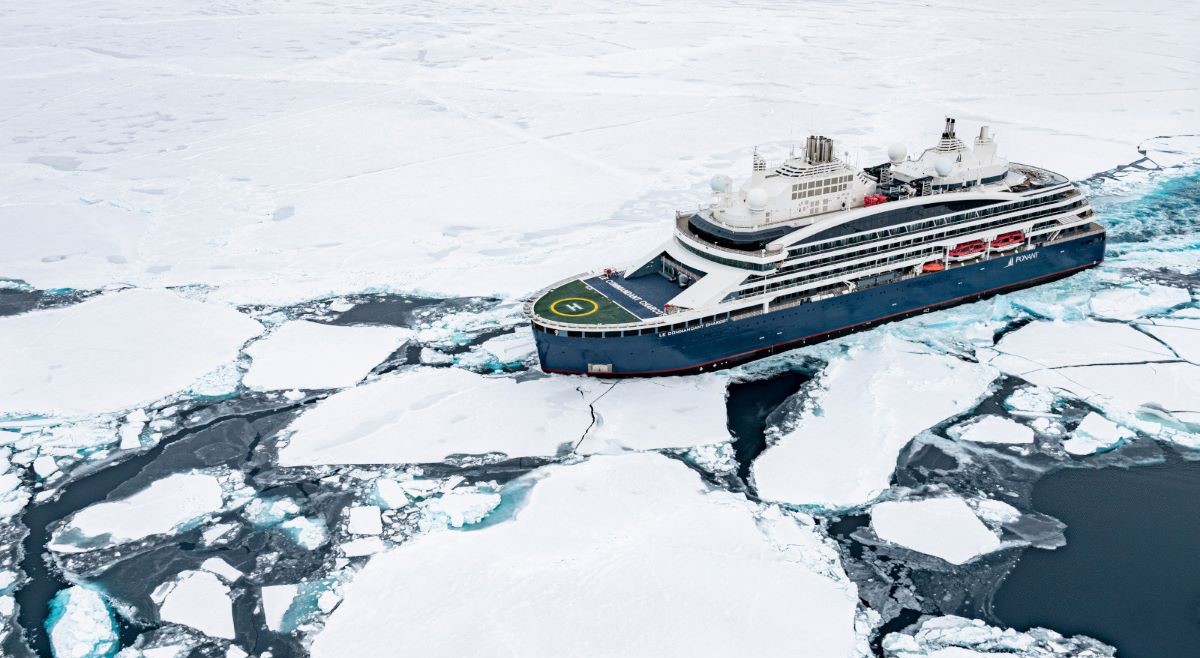
Expedition to the Geographic North Pole at 90° N | Le Commandant-Charcot
Travel to the North Pole, the white end of the world
All lines of longitude converge at 90° north latitude. The Arctic Ocean is 4,087 m deep here. Wherever you look, the view is to the south. Across a seemingly endless, silent desert of snow and ice that characterizes every journey to the North Pole.
Unlike the South Pole, the North Pole is not located on the mainland, but on a floating ice sheet two to three meters thick. This is why Antarctica is a continent, but the Arctic is not. The year here consists of one long day and one long night: from March 21 to September 23, the sun does not set, and for the rest of the year, it does not rise. We are planning your trip to the North Pole during this very time: during the midnight sun, which bathes the ice, the sea, and the sky around you in constantly changing color combinations. An Eldorado for photographers.
The Arctic Ocean – hostile to life and therefore all the more fascinating
The North Pole is located in the middle of the Arctic Ocean, an ocean covering 14 million km². The Arctic Ocean has many names: Arctic Ocean, Northern Ice Sea, or simply Arctic. Incidentally, the latter comes from Greek and means "bear." This has nothing to do with polar bears, but rather with the constellation "Ursa Major." In ancient times, the area around the North Pole was located under this constellation.
The Arctic Ocean is covered by ice over a large area. Unlike Antarctica at the South Pole, there is no land under the ice, only water. At its deepest point, it is 5,669 m deep. It is only navigable for three to five months of the year. The neighboring countries of Russia, Alaska (USA), Canada, Norway, Greenland (Denmark), and Iceland use either the Northeast Passage or the Northwest Passage for shipping during this time.
For a long time, the Arctic Ocean was one of the last "blank spots" on our planet. Due to the hostile conditions, it was almost impossible to explore this area, and numerous expeditions failed. Even today, the northernmost ocean still exerts a magical attraction on adventure seekers. Anyone who ventures on such an expedition will discover that, despite its remoteness, the Arctic Ocean and its coasts are teeming with life.
Today, various trips to the North Pole make it possible to experience the fascination of this unique ocean up close. Anyone who has been there once wants to return.
Surprising biodiversity on a trip to the North Pole
Despite the arctic cold, a surprising number of animals live in the Arctic Ocean. This makes trips to the North Pole ideal for observing various whales: almost all whale species can be found in the Arctic Ocean, from large species such as blue whales and fin whales to smaller minke whales. Beluga whales are even found in very northern regions.
The bird life at the Arctic Ocean is also unique. On an expedition to the North Pole, you will have many opportunities to observe a wide variety of birds breeding and raising their young.
If you pass Banks Island on your expedition through the Arctic Ocean, you will have the opportunity to see a very special animal: the world's largest population of musk oxen lives in Aulavik National Park. An encounter with these animals will take you back thousands of years: these impressive creatures appear so primeval in their natural environment, far away from any civilization.
Then, of course, there are the animals that everyone immediately thinks of when traveling to the North Pole and the Arctic: seals, walruses, reindeer, and, of course, polar bears. With a little luck, you may see a polar bear hunting from a safe distance from the ship.
Also exciting: the difference between the geographic and magnetic North Pole
When you think of the North Pole, you often imagine a fixed point. But in fact , there are two: the geographic North Pole and the magnetic North Pole. The geographic North Pole is the point at which the Earth rotates —quasi at the very top of the globe. It is surrounded by ice in the middle of the Arctic Ocean, but not on solid land. And it always remains in the same place.
The magnetic north pole, on the other hand, is the point at which the Earth's magnetic field is perpendicular to the Earth's surface and to which compass needles point. It is also located in the ice, but constantly shifts due to changes in the Earth's magnetic field – by up to several kilometers per year. For travelers, this means that a compass does not point directly to the geographic North Pole, but to the magnetic North Pole, which can be several hundred kilometers away. GPS devices, on the other hand, use the geographic North Pole as a reference and are therefore usually more accurate for navigation.
The direct route: the classic North Pole journey
Stand at the northernmost point on Earth. Bathe in the ice-cold water at the North Pole. If you have this wish, there is only one way to get there: with an icebreaker. In any case, your trip to the North Pole will remain etched in your memory. The landscape of pack ice, thin ice fields, and open water is constantly changing and is unique every time. The silence, the vastness, the special lighting conditions: these impressions will stay with you forever—and change your view of the world forever.
The end of the world is white and cold. But also beautiful and full of life.
Do you have any questions about our North Pole trips?
just call