Greenwashing in the travel industry: Between green promises and legal limits
Welcome back, dear ice pioneers!
Today we're talking about a topic that affects us all – greenwashing in the travel industry. For a long time, many companies have advertised with vague environmental promises that were often more style than substance – but that's now coming to an end.
The EU is providing clarity on environmental promises: anyone who advertises "sustainability" must also be able to prove it. What does this mean for the travel industry? We'll take you on a brief tour of the new regulations.
What is greenwashing—and why is everyone talking about it?
Greenwashing describes the phenomenon of companies presenting themselves as more environmentally friendly than they actually are. It is therefore not about genuine sustainability, but rather about the appearance of it.
Often, all it takes is a green coat of paint in advertising, a vague promise on the website, or a label with a leaf icon that is not explained in detail. The result: consumers get the impression that a product is particularly environmentally responsible —without this claim being verifiable or comprehensible.
Greenwashing can take many forms: a hotel that presents itself as sustainable but operates a huge pool in a water-scarce region; an airline that promises CO₂-neutral flights because it invests in reforestation projects—even though such projects only effectively bind CO₂ after decades.
Or a cruise line that proudly highlights its recycling project while its ships continue to run on heavy fuel oil and forego technologies such as low-emission engines or energy management systems—even though these measures would have a noticeable impact on the environment and climate balance.
The green jungle of labels
In recent years, a veritable jungle of green labels has sprung up across Europe: products are suddenly "climate-friendly," services "sustainable," and even air travel "CO2-neutral." Sounds impressive—if it weren't for one small problem: no one knows exactly what any of it actually means.
In 2020, there were around 230 active eco-labels in Europe, plus around 100 private green electricity labels. The promise: those who choose green-labeled products are doing good for the planet.
However, a study conducted by the European Commission in the same year brought disillusionment: 53% of the environmental claims examined were vague, misleading, or simply unfounded. And 40% could not be substantiated at all.
The reason? There was simply a lack of clear EU-wide rules on what companies are allowed to claim—and how they must substantiate these claims. That is precisely what is changing now. Welcome to the era of anti-greenwashing regulation.

A guide through the label jungle: How the EU is now setting limits on greenwashing
The EU has cracked down on greenwashing—and is bringing more clarity to the jungle of environmental promises with new rules.
The focus is on the Unfair Commercial Practices Directive, which has been protecting us from misleading advertising since 2005. But times are changing—and in order to meet the new challenges posed by digital and green marketing tricks, the EU has now revamped the directive with the new "Directive on Empowering Consumers for the Green Transition."
This was adopted in March 2024 and will come into force in all EU member states from September 2026. With this new regulation, the EU is now setting clear boundaries and ensuring that there is finally more transparency and accountability for all green promises:
Companies need to make their green promises clearer and more transparent —it is no longer enough to say "climate neutral" or "environmentally friendly" without providing solid evidence.
In addition, anyone who wants to advertise with a sustainability label must be able to demonstrate genuine, official standards or recognized certifications. Simply sticking a label on a product is a thing of the past—today, it's all about real action!
Particularly important: statements such as "climate neutral," "CO₂-compensated," or "climate positive" may no longer simply appear on products or services in the future if they are based solely on compensation measures. Such termsoften give the impression that a product itself or its manufacture has no environmental impact —even though this is not true.
This is precisely why such statements will be prohibited in future, unless they are based on verifiable reductions in emissions throughout the entire life cycle of the product – and not on offsetting measures outside the value chain.
And it gets even more exciting: soon the Green Claims Directive will come into force, providing even more clarity! In future, companies will not only have to specify whether their environmental claims apply to the entire product or only part of it —they will also have to substantiate their claims scientifically and take into account the entire life cycle of their product. But more on that another time!
The goal is therefore quite clear: only genuine, verifiable sustainability should actually be sold as such.
So what does this mean for the travel industry and for those of us who want to travel sustainably?
No more superlatives – A sustainability check in Lapland
An example from Lapland shows us how the new regulation works: The Pyhä ski resort, which once marketed itself as the first carbon-neutral ski resort in the Nordic countries and publicly set itself the ambitious goal of becoming "the cleanest ski resort in the world," had to completely revise its advertising claims.
All marketing communications, from tickets and flyers to signs, advertisements, and the website, now had to be adapted, and the large banner proudly proclaiming the "cleanest ski resort in the world" has since been removed. And why? Quite simply because these grand promises could not be backed up with the necessary evidence that is now required.
Today, Pyhä is committed to more transparent statements: its ski-in accommodations have now been awarded the Green Key certificate—a sign that they meet the strict criteria of the UN sustainability goals.

Climate-neutral flying? Show me the proof!
Even above the clouds, greenwashing does not go undetected. The aviation industry is currently experiencing what it means to handle green statements responsibly.
Perhaps you've done it too: when booking a flight, you quickly tick the "climate-neutral travel" box—a little extra for the planet, and a good feeling included. Sounds almost too good to be true!
This is precisely why the European consumer organization BEUC took a closer look—and discovered that many of these green promises are still shrouded in fog. As a result, the EU Commission wanted to know more—and asked 20 airlines about their green promises. Among them were well-known names such as Lufthansa, Air France, KLM, Ryanair, and easyJet.
With their "green fares ," Lufthansa and Co. have given the impression that an additional payment for climate protection projects or sustainable aviation fuels (SAFs) could completely offset the CO2 emissions of a flight.
But here's the catch: SAFs may be less harmful than conventional kerosene, but they currently account for only a tiny fraction of total global aviation fuel consumption —about 0.3 percent. And even if this small amount reduces CO2 emissions by 80%, it is far from enough to offset the entire carbon footprint of a flight. What's more, sustainable aviation fuels are currently far from being ready for market production,so availability in larger quantities is not expected anytime soon.
The discrepancy between the airlines' grand promises and what is actually achieved is not only disappointing—it also leaves many passengers with a false impression of how climate-friendly their flight really is.
The German Environmental Aid Association (DUH) also took notice of this practice and filed a lawsuit against Lufthansa, which advertises with the statement "Offset CO₂ emissions by supporting climate protection projects." The Regional Court of Cologne ruled in favor of the lawsuit and clarified:
The advertised promise of climate neutrality raises false expectations among the public. An important signal—not only for Lufthansa, but for the entire industry: sustainability must be sound.

In conclusion, it can be said that the travel industry is changing. It is moving away from vague promises and toward greater responsibility, transparency, and real progress. And the best part? We can continue to discover the world, this time with a clearer compass in hand.
Until next time—when we explore the next sustainability topic together.
Best regards,
Patricia
Head of Sustainability & Nature Positive Strategy
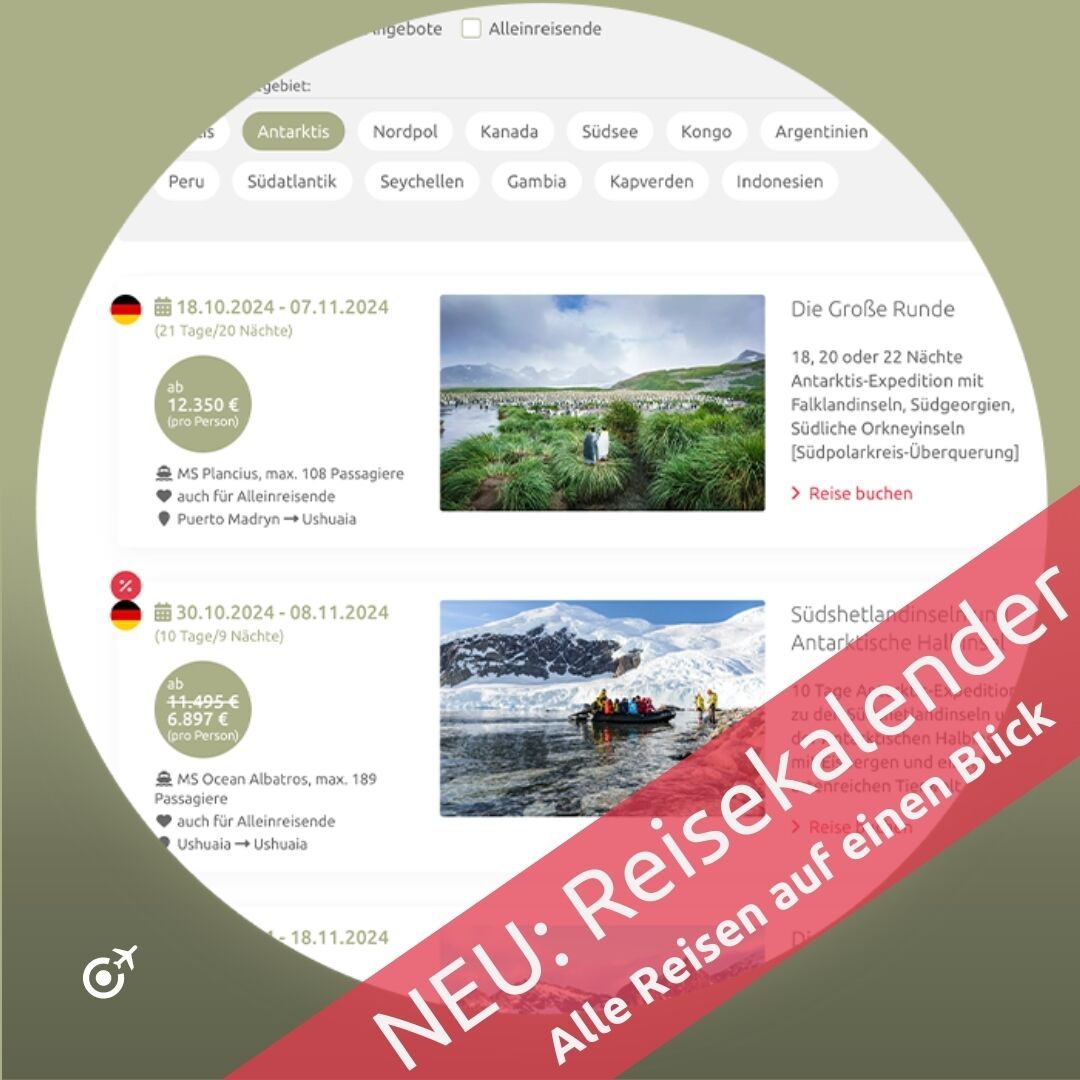
Travel finder: All Antarctic trips and offers at a glance
Browse through the calendar and find your perfect Antarctic trip

Stephanie Gräf
Travel expert, inventia | Travel beyond the ordinary
Specialist in personalized and exciting trips around the globe.
I am your contact person for questions and bookings regarding your trip.
You can reach me by phone or email:
+49 (0)201 858 90 960
welcome@inventia.de
Customized travel offer

Sie interessieren sich für die Antarktis, wissen aber nicht, wo Sie anfangen sollen?
Unser KOSTENLOSER Antarktis-Miniguide bringt Licht ins Eis.

Newsletter: Travel beyond the ordinary
Stay in touch with us and receive our latest travel ideas on a regular basis.
Shall we stay in touch?
Further articles on the topic of sustainability

Encountering polar bears: Searching for traces in Canada, Spitsbergen, and Greenland

ESTA for South Georgia – Entry authorization now mandatory

SAF. How sustainable aviation fuels could revolutionize aviation

Protecting polar bears: The work of Polar Bears International

How climate change threatens polar bears and how conscious travel can help
Our sustainability promise

Responsible travel: A guide for travelers in the Arctic
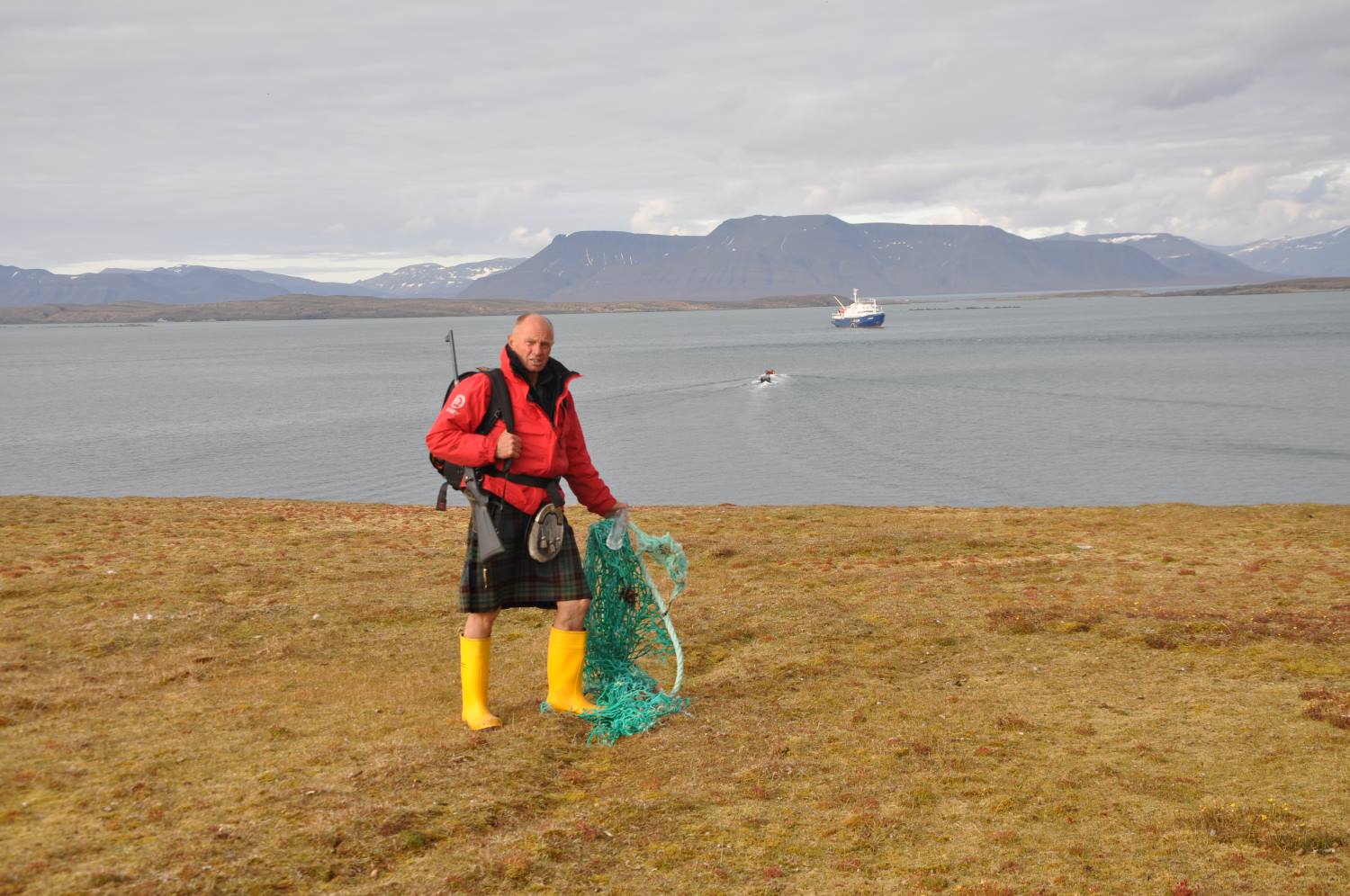
Clean Up Svalbard – Working together for a clean Arctic