Emperor Penguin: Everything About This Animal & Where You Can See It
“March of the Penguins” has captivated millions of moviegoers and introduced the emperor penguin to a global audience. What the film doesn’t show is just how difficult it actually is for most travelers to Antarctica to see one in the wild. Unlike its relatives, it does not build a nest but instead usually breeds on fast ice near the Antarctic coast, often kilometers away from the nearest ice-free area. That is exactly what makes an encounter so rare—and so special.
In this article, you’ll learn what makes the emperor penguin biologically unique, where it lives, and how it struggles to survive. And—perhaps most importantly—exactly where you can see them for yourself. After all, there are actually a few opportunities to see emperor penguins in the wild.
- Fact Sheet: The Emperor Penguin by the Numbers
- Where can I see emperor penguins?
- The Difference Between the King Penguin and...
- Do emperor penguins really live at the South Pole?
- Survivors in the Perpetual Ice
- Reproduction: A balancing act that lasts for months
- What does an emperor penguin eat?
- How endangered is the emperor penguin?
- The Emperor Penguin's Enemies
- Conclusion
Fact Sheet: The Emperor Penguin by the Numbers
Where can I see emperor penguins?
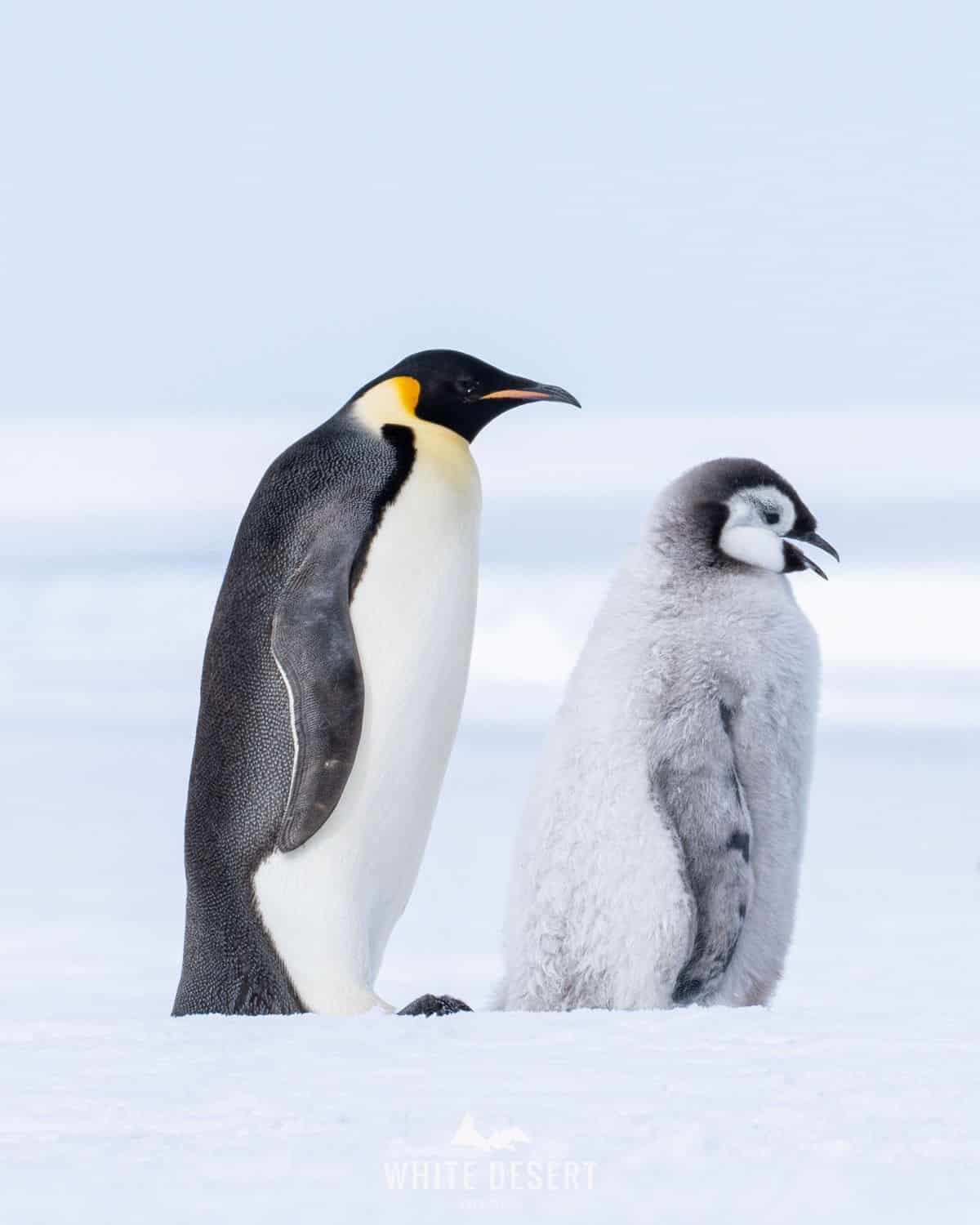
First, the good news: You don't have to be a scientist or researcher to encounter an emperor penguin. There are three ways to do it—and we have several of them on our itinerary.
By Boat and Helicopter: Snow Hill Island
Emperor Penguins on Snow Hill Island | (c) Quark Expeditions
The route to the world’s northernmost emperor penguin colony leads to the Weddell Sea, on Snow Hill Island. Thick sea ice makes approaching the colony considerably more difficult—the ship is often unable to reach the colony under its own power. Whether a landing is possible depends on the local weather and ice conditions; consequently, very few ships are even equipped with helicopters to bridge this distance. If the operation is feasible, the helicopter lands on the ice at a safe distance from the colony, and you cover the last few meters on foot—then observe the animals while adhering to strict social distancing rules. Anyone who experiences this moment finds themselves standing in front of a colony of several thousand animals, right in the middle of the ice.
About Snow Hill Island Tours
By Air Expedition: To the Geographic South Pole

Emperor penguins in Gould Bay | @ALE
Anyone venturing into the interior of Antarctica books a flight expedition to the geographic South Pole—usually combined with a separate trip to a colony in Gould Bay or Atka Bay, since there are no emperor penguins living at the Pole itself. It’s an experience that very few people worldwide ever get to have.
About South Pole Expeditions
With a little luck: at Rossmeer
Emperor penguins in McMurdo Sound, Ross Sea | (c) Oceanwide Expeditions by Rolf Stange
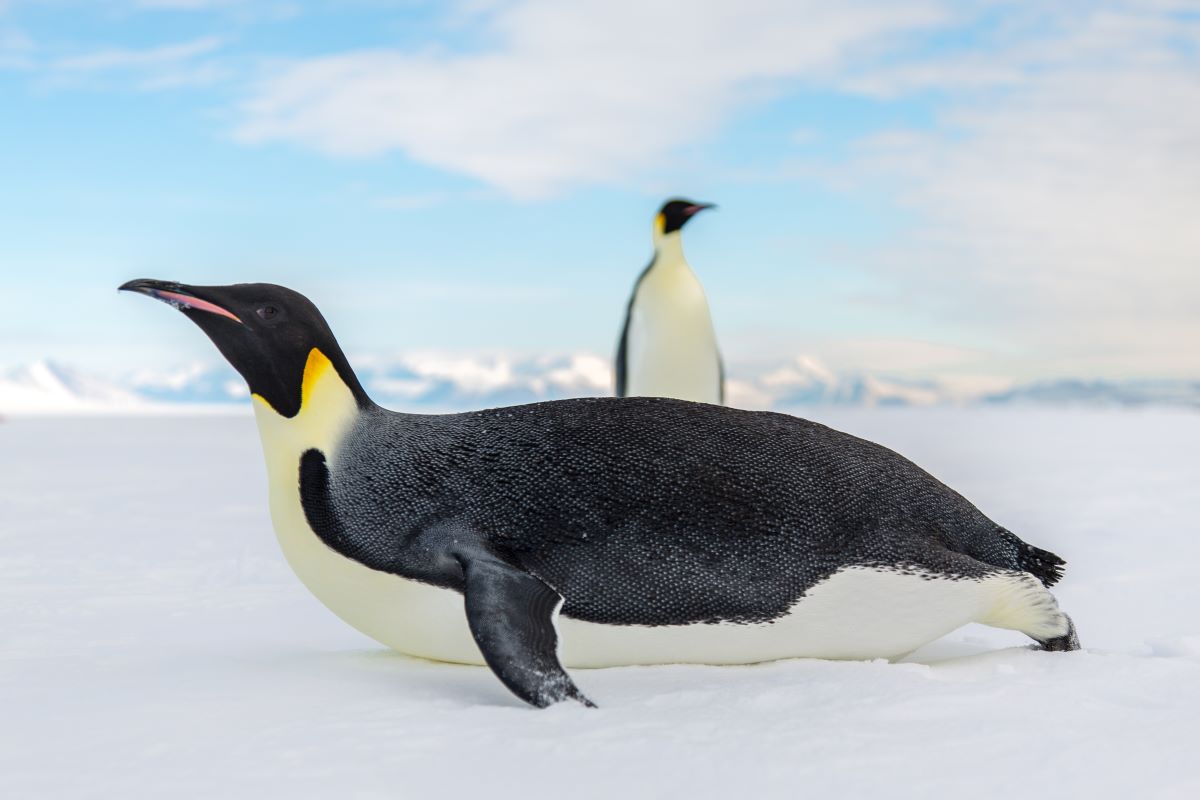
Emperor penguins in the Ross Sea—the world’s largest open-ocean marine protected area (established by CCAMLR in 2016 and effective in 2017)—are a bit harder to spot; the colonies are scattered across vast ice fields, so you’ll need a bit of luck here. But the Ross Ice Shelf, Mount Erebus, and the historic huts of Shackleton and Scott are all waiting to be explored.
About the Ross Sea Expeditions
We design all of our emperor penguin tours in accordance with the guidelines of the International Association of Antarctica Tour Operators (IAATO)—conservation is our top priority during every encounter with a colony(for more information, see our blog post “A Guide to Responsible Travel in Antarctica”).
The Difference Between the King Penguin and...
At first glance, they are easy to confuse, but upon closer inspection, they are clearly distinguishable: The emperor penguin is the larger of the two species and lives exclusively in Antarctica, while the king penguin also nests on sub-Antarctic islands such as South Georgia.

Three king penguins on the beach | © Adobe Stock
On our trips, you’ll see them there more often than emperor penguins. The difference in color is most noticeable in the ear patches: on king penguins, they are a particularly vivid orange, while the corresponding yellowish-to-orange patches on emperor penguins are paler.
Do emperor penguins really live at the South Pole?
This question comes up surprisingly often, so let’s set the record straight: Emperor penguins live exclusively in the Southern Hemisphere, in Antarctica—never at the North Pole, where there are no wild penguins, though you might encounter polar bears there instead.
However, it’s also important to make a second distinction: Antarctica and the geographic South Pole are not the same thing. The South Pole is located at 90° south, deep within the continent—emperor penguin colonies, on the other hand, are found almost exclusively near the coast, on the sea ice. Those who actually travel to the geographic South Pole—as on our flight expeditions—usually combine the visit with a separate trip to an emperor penguin colony, since the penguins do not live at the Pole itself.
Survivors in the Perpetual Ice
Emperor penguins breed in the coldest region on Earth—where air temperatures drop below -50 °C and wind speeds can reach well over 100 km/h.
Insulation: How Feathers Protect Against the Cold
This is made possible by a multi-layered, very dense plumage, a layer of blubber up to 3 cm thick, and comparatively small beaks and flippers, which minimize heat loss. On land, special muscles raise the feathers, trapping an insulating layer of air; in the water, the feathers lie flat and become waterproof.
Diving: Deliberately Lowering Your Heart Rate

Emperor penguin diving | © WikiImages-Pixabay | Aurora
A remarkable adaptation is also evident when diving: Emperor penguins can significantly lower their heart rate and thus regulate their oxygen consumption—the extent of this depends on the specific dive.
Appearing: The Air Bubble Trick
When they surface quickly, air escapes from the animals’ plumage. Researchers believe that the tiny bubbles formed in the process reduce drag and can thus facilitate particularly rapid ascents—allowing the animals to dash effortlessly onto high ice ridges. On land, however, things move at a more leisurely pace: Emperor penguins reach speeds of about 2.5 km/h when waddling, but they move much faster when sliding on their bellies across the ice.
Reproduction: A balancing act that lasts for months
Hardly any other animal reproduces under such extreme conditions as the emperor penguin—a process involving several risky stages in which males and females take turns in a strictly defined sequence.
The March to the Colony
Before courtship even begins, the animals have often already completed a considerable trek: Starting in April, emperor penguins migrate from the open ocean to their breeding colonies, sometimes traveling 50 to 120 kilometers across the pack ice. Once they reach their destination, the males strut about, press their beaks against their chests, and sing their characteristic breeding call.
The Risky Egg Handoff
After mating, the female lays her only egg of the year in May or June—and hands it over to the male in a delicate moment before returning to the sea herself to feed for about two months. This handoff is risky: if the egg cools down on the ice during the process, it is quickly lost.
115 Days of Fasting: The Male's Task
The male then balances the egg on his feet for 65 to 75 days, protected by a special, featherless abdominal fold—without eating himself. In total, he fasts for about 115 consecutive days and loses a significant portion of his body weight in the process. To survive this, the males huddle together by the thousands, forming so-called “huddles”: groups in which inner and outer positions constantly alternate so that no one is permanently exposed to the cold.
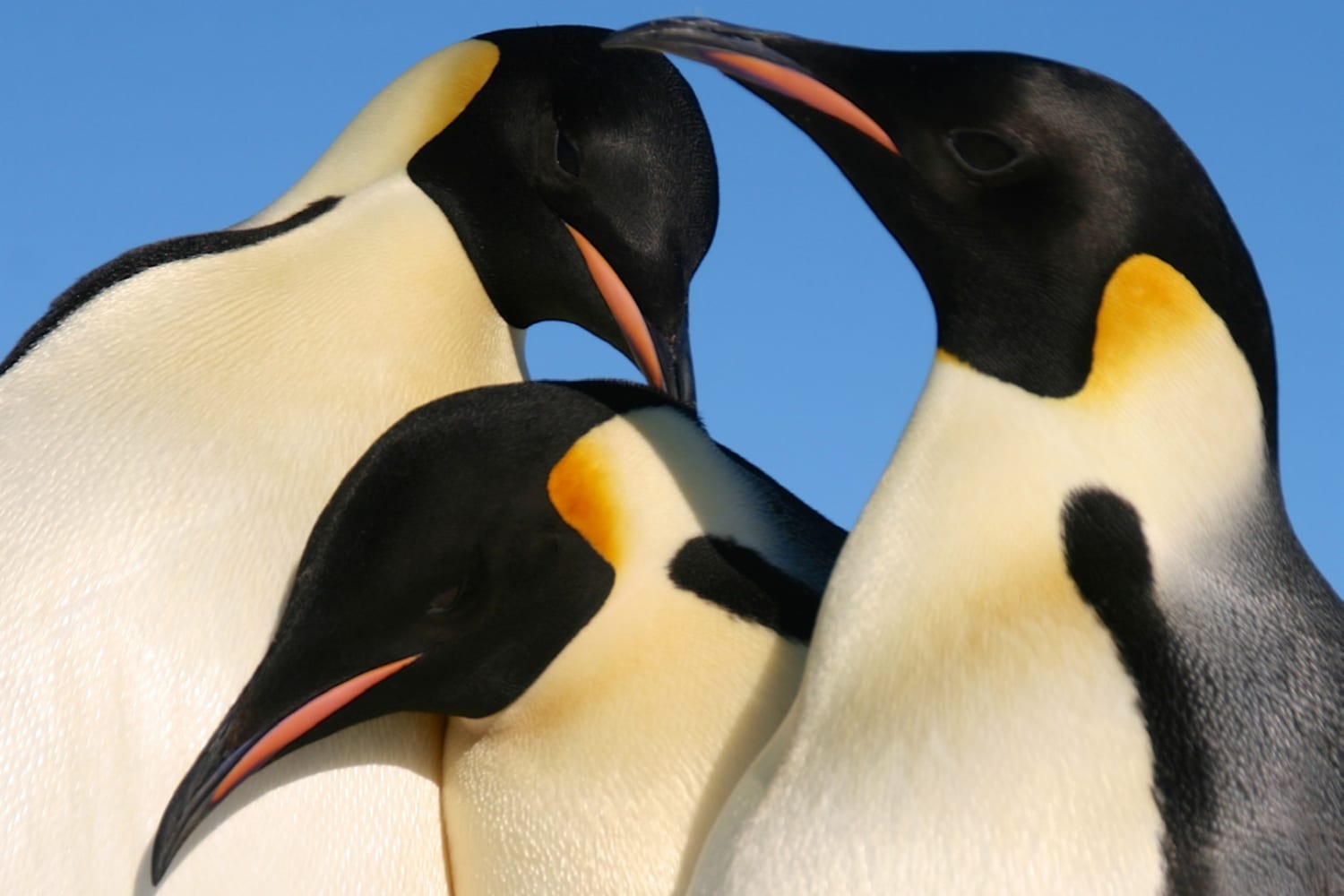
When the female returns, she finds her mate—despite thousands of animals that look identical—by recognizing his unique call. Emperor penguins stay together for only one season; the following year, most of them find a new partner.
Emergency Treatment: “Goiter Milk”
If the female is unable to return in time, the starving male gets by during the initial period after hatching using a substance produced by his own body in the esophagus, similar to the “crop milk” of pigeons—a mechanism found in only a few bird species worldwide besides emperor penguins; however, this reserve lasts only a few days.
The Nativity Scene: Chicks Together

Emperor Penguin Colony: Adults and Chicks on Sea Ice | (c) AdobeStock#314564438 by Sam
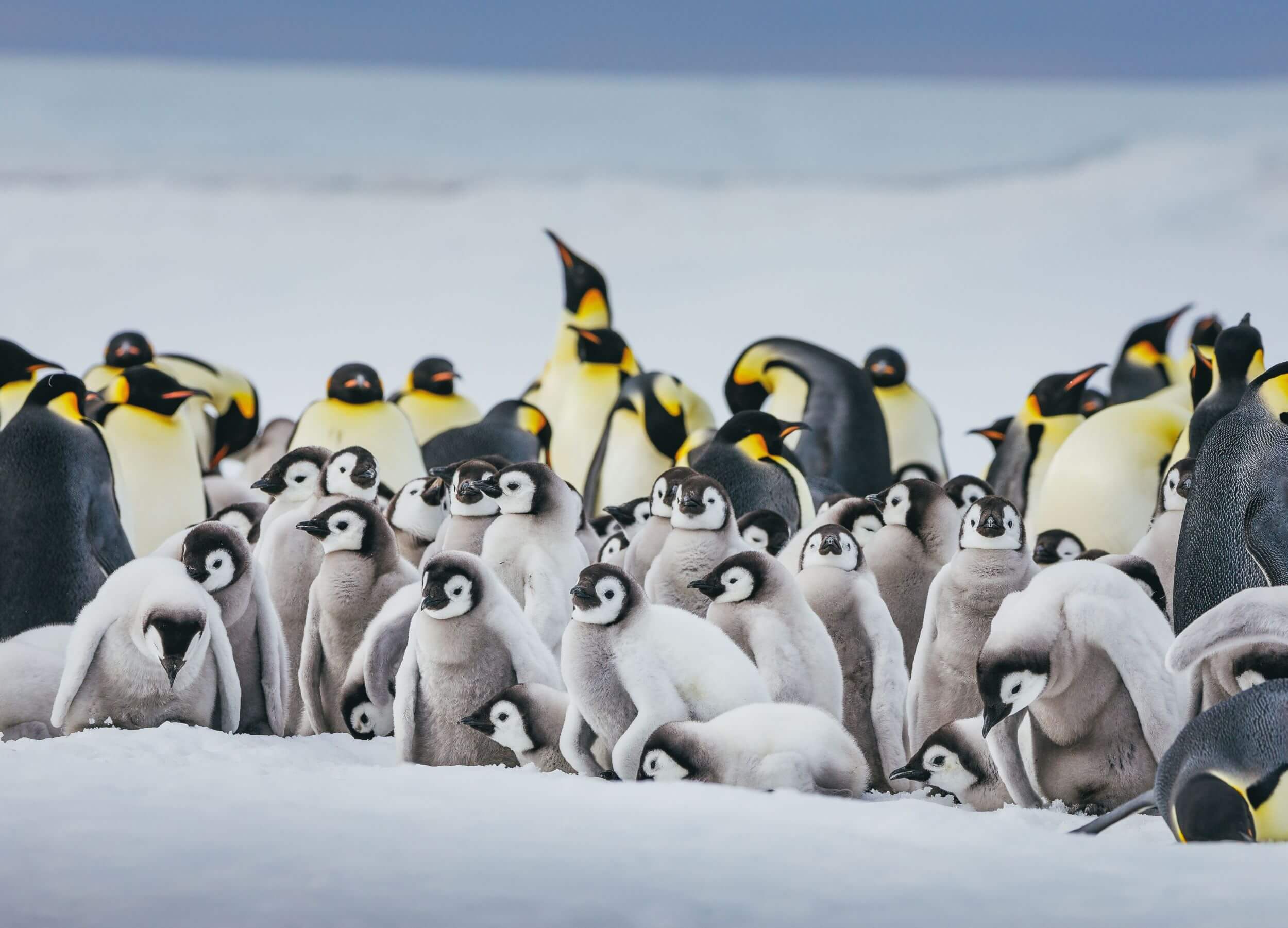
Once the chicks are about 50 days old, both parents go out in search of food at the same time. During this time, the chicks gather in large groups and huddle together—a survival strategy, as the mortality rate among emperor penguin chicks is high during their first year of life.
What does an emperor penguin eat?
Their diet consists mainly of fish, particularly the Antarctic silverfish, supplemented by krill and squid. Adult animals typically consume two to three kilograms of food per day—before molting or at the start of the breeding season, this amount can double to as much as six kilograms in order to build up sufficient fat reserves.
How endangered is the emperor penguin?
Emperor Penguins Cuddling | @ALE
There has recently been an important development in this area: In April 2026, the International Union for Conservation of Nature (IUCN) upgraded the emperor penguin’s status from “Near Threatened” to “Endangered.” Satellite data already shows a decline of about 10% between 2009 and 2018—equivalent to over 20,000 adult birds. The main cause is the early breakup of fast ice—that is, the sea ice attached to the coast—which the birds need for breeding and molting. If this trend continues, the global population could be halved by the 2080s.
To put this into context: There are currently 66 known emperor penguin colonies in Antarctica. Caution is advised when considering the total population: The most frequently cited figure of approximately 595,000 birds originally comes from a 2009 satellite census and is still used today—even by the IUCN itself—as a reference figure, but it is not a current count. More recent satellite-based surveys show a decline of about 10% for the period up to 2018, as described above; there is currently no equally reliable new total figure for all of Antarctica.
The Emperor Penguin's Enemies
Adult emperor penguins have virtually no natural predators on land or on the ice. The greatest danger lies in the water: leopard seals often lie in wait for penguins near the ice edge, and orcas may also hunt them. This makes the moments when the penguins move between the sea ice and the water particularly risky.
The situation is different for chicks. They can fall prey to giant petrels and skuas even while still in the breeding colony. Weakened or unprotected chicks are particularly at risk.
However, the far greater threat to the species as a whole today does not come from natural predators, but from the loss of its habitat due to climate change.
Conclusion
The emperor penguin remains one of the most impressive animals in Antarctica, precisely because encountering one requires so much preparation and effort. Anyone who has ever stood in front of a colony on the open pack ice knows why this detour is worth it. The following expeditions offer you the chance to encounter emperor penguins in person:

Travel finder: All Antarctic trips and offers at a glance
Browse through the calendar and find your perfect Antarctic trip

Stephanie Gräf
Owner & Founder
Since 2002, I have been personally advising clients on unique expeditions and private trips, small-ship cruises, and journeys to remote regions of the world.
We'd be happy to discuss your trip with you in person.
Why not contact me right now at Phone: +49 201 85890960 or email welcome@inventia.de.
Or schedule a free, no-obligation one-on-one phone call (also via WhatsApp or Wi-Fi), a Teams or Zoom meeting here—even in the evenings or on weekends:

Are you interested in Antarctica but don't know where to start?
Our FREE Antarctic Mini-Guide sheds light on the ice.

Newsletter: Travel beyond the ordinary
Stay in touch with us and receive our latest travel ideas on a regular basis.